
Written by: Rachel Mohr, Aletheia Financial Forensics, LLC
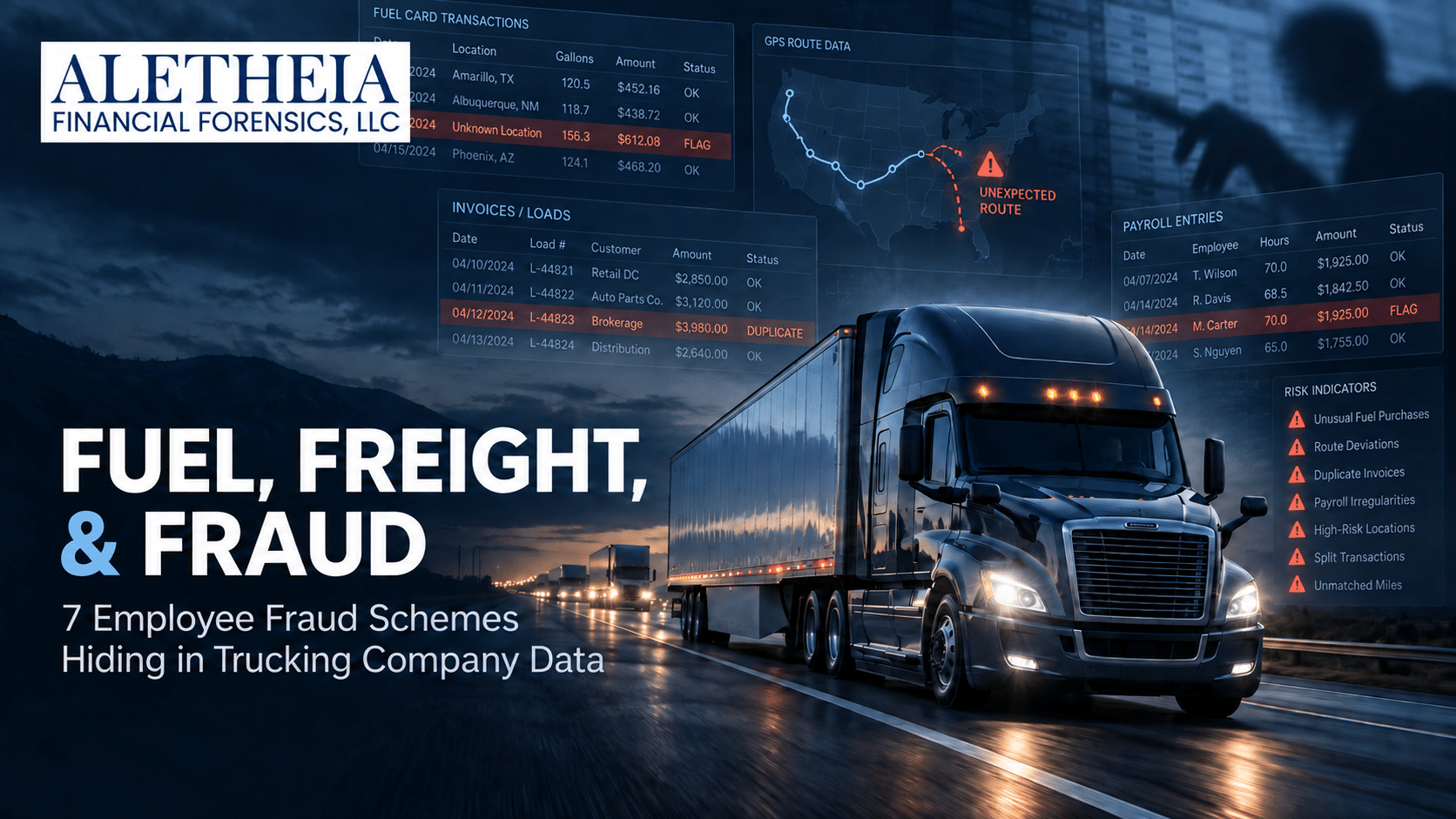
Trucking Fraud: 7 Employee Fraud Schemes Hiding in Trucking Company Data
In July 2026, West Virginia truck driver Jeffrey Jeffers pled guilty to wire fraud after admitting to stealing more than $510,000 from his employer through fraudulent fuel-card charges during a period of over a year and a half. Jeffers admitted to using fictitious service station names, Northwestern Marathon and Northeastern Marathon, using the Square and Stripe online payment platforms and billed his employer for fuel purchases that never occurred. Jeffers used a relative’s Canton, Ohio, address for the fictitious businesses. Jeffers admitted that his delivery routes normally never required refueling outside the company’s distribution facility. As part of the plea agreement, Jeffers agreed to a money judgement and forfeiture of a truck in which proceeds from the crime were traced.
Cases like this are not isolated. The Association of Certified Fraud Examiners’ Occupational Fraud 2026: Report to the Nations included over 70 cases involving transportation and warehousing companies. Those cases produced a median fraud loss of $200,000. Trucking companies are particularly vulnerable due to decentralized operations, extensive geographic footprints, and time-sensitive transactions. Fortunately, employee fraud often leaves a trail in operational and financial data. Fuel purchases, GPS records, payroll data, maintenance invoices, vendor payments, and shipment information can all reveal patterns that warrant closer scrutiny. These patterns do not establish that fraud occurred, but they can help companies prioritize transactions and relationships for further review and investigation.
1. Fuel Card Fraud
As seen in the case above, fuel card fraud is an attractive target for fraud and abuse. Common schemes include personal fuel payments, fake fuel transactions at fictitious stations, fueling non-company vehicles, and manipulating fuel quantity. While an individual fuel purchase may appear legitimate when reviewed in isolation, comparing transaction data with operational records often reveals suspicious activity.
What to watch for
- Fuel purchases are inconsistent with GPS locations
- Transactions that exceed a vehicle’s fuel tank capacity
- Multiple fuel purchases occur within an unreasonable period
- Fuel purchases during non-working hours
Analyzing fuel card transactions alongside GPS, dispatch, and ELD (electronic logging device) data can help identify patterns indicative of misuse and uncover fraudulent activity that might otherwise go undetected.
2. Payroll and Ghost Employees
Employee compensation systems are often complex, creating opportunities for payroll fraud and manipulation. Common schemes include payments continuing after employee termination, the creation of ghost employees, inflated work hours and miles driven, and unworked overtime.
What to watch for
- Shared direct deposit accounts
- Labor hours exceeding logbook
- Unusual or consistently high overtime
By comparing payroll records with ELDs, GPS, dispatch, and load data, organizations can determine whether compensation aligns with actual work activity.
3. Maintenance and Repair Fraud
Maintenance and repair fraud can involve employees, vendors, or a combination of both. Common schemes include billing for repairs that were never performed, theft of inventory or replacement parts, inflated repair costs, unnecessary maintenance work, and vendor kickback arrangements.
What to watch for
- Repairs on the same equipment
- Excessive part purchases or repurchases
- Repair expenses that significantly exceed fleet averages
- Maintenance records showing repairs while a vehicle was operating elsewhere
Comparing maintenance invoices, work orders, inventory records, and GPS data can help investigators identify inconsistencies and determine whether reported repairs were legitimate.
4. Vendor Kickbacks and Employee-Related Vendors
Trucking companies frequently use numerous vendors for maintenance, towing, tires, parts, roadside assistance, and subcontracting. An employee could exploit the vendor process by creating a fictitious company, directing business to an undisclosed related party, or receiving kickbacks and other personal benefits in exchange for contracts.
What to watch for
- Concentrated spending with a single vendor
- Shared vendors and employee information
- Invoices repeatedly falling just beneath approval thresholds
- New vendors immediately receiving significant payments
To determine which vendors are legitimate, companies can conduct vendor master file analysis, compare pricing across vendors, and review vendor ownership with employee relationships.
5. Freight Billing Manipulation
Employees with access to customer, carrier, or payment information may be able to manipulate records, redirect funds, create fictitious loads or invoices, or inflate freight charges.
What to watch for
- Lack of supporting documentation on invoices
- Payments without corresponding load activity
- Duplicate payments for the same load
- Manual payments outside normal procedures
Detective procedures include reconciling invoices with load confirmations and delivery records as well as tracing payment receipts to bank deposits.
6. Company Card and Expense Reimbursements
Company cards and expense reimbursements can be used to disguise personal purchases as business expenses. Potential schemes include fictitious receipts, duplicate expense claims, and inflated travel/lodging costs.
What to watch for
- High reimbursement rates by specific employees
- Expenses inconsistent with route or work schedules
- Multiple submissions for identical expenses
Organizations can match expenses to dispatch and travel records, use data analytics to identify duplicate claims, and review supporting documentation to check for missing or inconsistent data.
7. ELD, Mileage, and Route Manipulation
ELDs, odometers, and GPS route trackers are valuable tools for verifying payroll, fuel usage, freight billing, and other operational activities. However, these systems are not immune to manipulation. Common schemes include falsifying driving activity, inflating mileage, altering route information, or improperly editing ELD records to conceal unauthorized activities.
What to watch for
- Unusual edits to ELD records
- Route deviations without documented business justification
- Excessive deadhead mileage
- Discrepancies between GPS and reimbursement records
- Mileage totals that exceed reasonable expectations for assigned loads
By comparing ELD records, GPS data, dispatch records, fuel purchases, and payroll information, organizations can identify inconsistencies that may indicate fraud or policy violations.

Following the Data Trail
One advantage trucking companies have in detecting fraud is that much of the necessary information already exists within their systems. Fuel-card records know when and where fuel was purchased. GPS and ELD systems know where trucks were located. Dispatch systems identify who was driving. Maintenance records show what repairs were performed. Accounting systems track where the money went. Forensic data analytics connects those systems and asks a simple question: Does the story told by one dataset agree with the story told by the others?
The West Virginia fuel card fraud scheme demonstrates how a seemingly routine business process can be exploited for years before being discovered. Fortunately, the same techniques used to investigate fraud after a loss can also be applied proactively to identify suspicious activity before losses escalate. Fraud may be hidden within the enormous volume of data generated by a trucking company, but so is the evidence needed to uncover it. The challenge is not whether the data exists. The challenge is knowing where to look.
Aletheia Financial Forensics, LLC is a boutique CPA firm based in Columbus, Ohio, that provides forensic accounting consulting and expert witness services. Its professionals also provide expert analysis, reports, and testimony in litigation and other high-stakes matters.
Learn more about how we reconstruct financial events through independent, defensible fraud investigations.