
Written by: Rachel Mohr, Aletheia Financial Forensics, LLC
Have you ever wondered how forensic accountants uncover financial fraud?
Forensic accountants look for patterns in financial data that reveal deception. Yet distinguishing between normal and suspicious numbers can be challenging, especially when dealing with large datasets. That’s where data analytics can be used, helping focus on which transactions or groups may warrant closer scrutiny.
In fact, there is a mathematical phenomenon that can detect numbers that are statistically unusual. It’s called Benford’s Law, and it is one of the most powerful tools for detecting irregularities in financial data.
What is Benford’s Law?
Benford’s Law is the statistical probability of a singular number (i.e., 0-9) occurring in a natural dataset. “Natural” numbers are ones that occur organically from real-world events and do not follow a particular numbering system. These numbers are not part of assigned sequences, used as identifiers, or artificially produced by human or random processes. Examples of non-natural datasets include phone numbers, employee IDs, and postal codes.
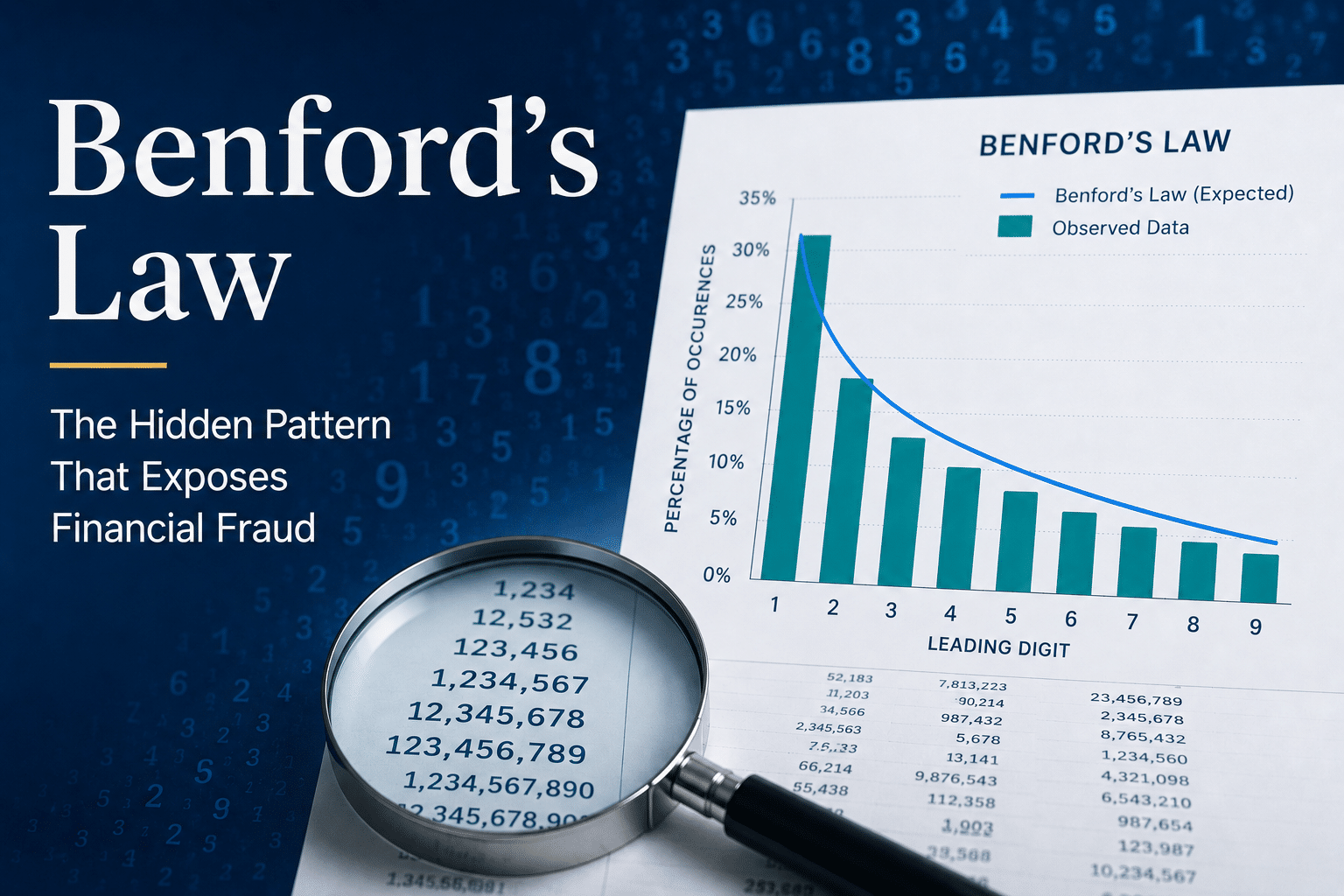
In naturally occurring datasets, the positions of digits are rarely random. Rather than each digit having an equal chance of appearing, smaller digits appear with greater frequency than larger ones. The table below illustrates the probability of each singular digit appearing in the first or second position of a multi-digit natural number.
| Probability of Position in Number | ||
| Digits | 1st Digit | 2nd Digit |
| 0 | – | 11.97% |
| 1 | 30.10% | 11.39% |
| 2 | 17.61% | 10.88% |
| 3 | 12.49% | 10.43% |
| 4 | 9.69% | 10.03% |
| 5 | 7.92% | 9.67% |
| 6 | 6.70% | 9.34% |
| 7 | 5.80% | 9.04% |
| 8 | 5.12% | 8.76% |
| 9 | 4.58% | 8.50% |
Table 1 – Newcomb, S. (1881). Note on the Frequency of Use of the Different Digits in Natural Numbers. American Journal of Mathematics, 4(1), 39–40.
As shown in Table 1, the single digit of “1” is statistically the most likely digit to appear first in a multi-digit natural number. In fact, out of 100 transactions, approximately 30 of them would begin with “1” while only approximately 5 would start with “9”.
The extraordinary thing about these percentages is that this pattern follows a consistent mathematical distribution regardless of the category of datasets or units of measurement. From financial transactions to scientific data, the distributions stay relatively the same. This consistency is what makes Benford’s Law such a powerful tool for detecting irregularities.
What are some limitations to Benford’s Law?
While Benford’s Law is a valuable tool in forensic accounting, it does not directly detect fraud. Instead, it highlights anomalies in data based on the statistical distribution found in naturally occurring numbers. In other words, testing a dataset against Benford’s Law simply reveals figures that deviate from expected values.
That said, Benford’s Law cannot be applied with full confidence to datasets containing non-natural numbers or those that are too small. Non-natural numbers, such as employee identification numbers or postal codes, cannot be tested using Benford’s Law as they do not follow the natural distribution required for analysis. Additionally, for Benford’s Law to work properly, the datasets should span a wide range and not be restricted by preset upper or lower limits.
Why does Benford’s Law matter in fraud detection?
Most fraudsters overlook or misapply Benford’s Law when fabricating numbers which can lead to anomalies or deviations from the expected statistical distribution. These occurrences can serve as red flags for forensic accountants, flagging areas that may warrant a closer examination.
To identify such irregularities, datasets are analyzed against Benford’s expected digital frequencies. Widely available tools such as Excel and Power BI or specialized forensic software can automate this process, allowing investigators to quickly visualize deviations and focus efforts where inconsistencies appear.
A notable example of where Benford’s Law can be applied is the SEC v C. Wesley Rhodes, et al. case. Wesley Rhodes, a former financial advisor in Oregon, was convicted of running a multi-million-dollar Ponzi scheme. The fraud was exposed in part due to statistical anomalies in the account statements sent to investors. Although the SEC did not reference Benford’s Law in its filings, the fabricated account values would have likely triggered an immediate statistical red flag.
One example of Benford’s Law in action is in a post-scandal financial analysis of Enron. Enron, an energy and commodity company, manipulated and fabricated numbers for financial reporting before going bankrupt. In 2005, Mark Nigrini performed an analysis of Enron’s finances using Benford’s Law. He found significant deviation from Benford’s expected frequencies, especially in the first digit, first-second digit, and second digit tests. These deviations were consistent with manipulated or fabricated numbers, which aligns to what investigators confirmed with Enron’s accounting practices.
When used appropriately and alongside other forensic tools, Benford’s Law becomes a powerful screening tool for identifying irregularities and potential fraud in financial data.
Sources:
Murtagh, J. What Is Benford’s Law? Why This Unexpected Pattern of Numbers Is Everywhere. Scientific American. 2023. Accessed at https://www.scientificamerican.com/article/what-is-benfords-law-why-this-unexpected-pattern-of-numbers-is-everywhere/.
Newcomb, Simon. “Note on the Frequency of Use of the Different Digits in Natural Numbers.” American Journal of Mathematics 4, no. 1 (1881): 39–40. Accessed at https://www.jstor.org/stable/2369148.
Nigrini, Mark J. “An Assessment of the Change in the Incidence of Earnings Management Around the Enron‐Andersen Episode.” Review of Accounting and Finance, January 1, 2005. Accessed at https://www.emerald.com/raf/article-abstract/4/1/92/360121/An-Assessment-of-the-Change-in-the-Incidence-of?redirectedFrom=fulltext.
U.S. Securities and Exchange Commission. SEC v. C. Wesley Rhodes, Jr. et al. Accessed at https://www.sec.gov/enforcement-litigation/litigation-releases/lr-20144.