
Written by: Rachel Mohr, Aletheia Financial Forensics, LLC
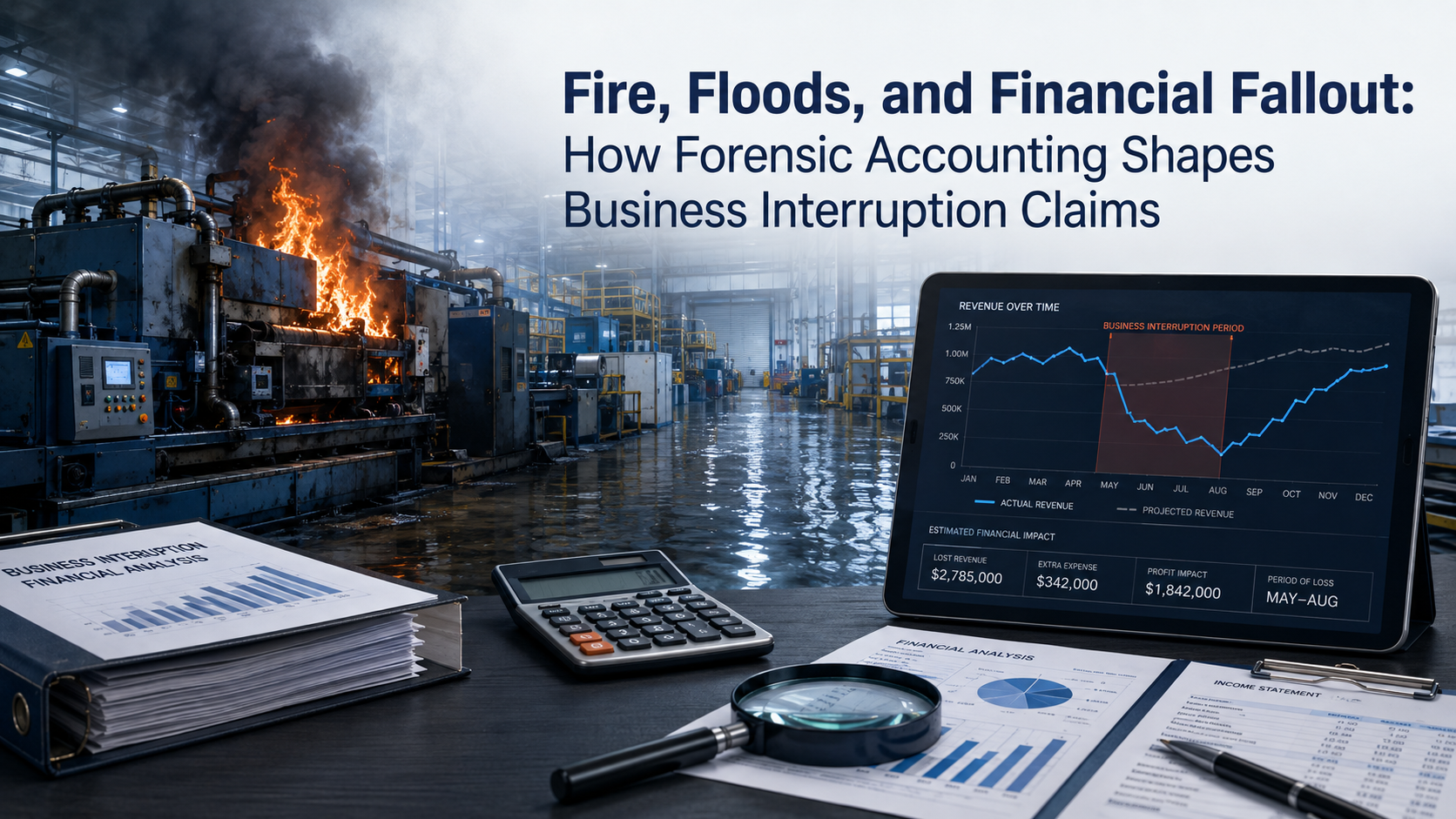
In the early morning of July 29, 2026, a piece of machinery caught fire at the Honda Transmission Plant-Ohio in Russells Point, Ohio. Fortunately, no injuries were reported, and the fire was quickly contained thanks to the rapid response of local firefighters. Although the fire was contained and no injuries were reported, the incident demonstrates how quickly an unexpected event can disrupt business operations.
To prepare for disruptions caused by unforeseen events, many businesses carry business interruption insurance. While property damage claims address tangible losses such as damaged buildings, equipment, and inventory, the financial consequences often extend far beyond physical damage. Determining the financial impact of a business interruption requires analysis, documentation, and professional judgment. In many cases, a forensic accountant helps translate the operational disruption into a quantifiable, supportable financial claim.
Understanding Business Interruption Claims
Business interruption insurance is generally designed to replace lost business income and cover qualifying continuing expenses when operations are suspended because of a covered event. Common causes of business interruption losses include fires, floods, severe weather, equipment failures, and cyber-attacks.
These claims may compensate businesses for several categories of loss. The first is lost profits resulting from interruption. Business income coverage generally measures the net income the business would have earned, together with covered continuing normal operating expenses, during the applicable restoration period. Because some expenses decline or cease when operations are interrupted, lost revenue alone does not represent the recoverable loss. Another category is continuing expenses, which remain payable even when operations are suspended. Common examples include rent, insurance premiums, and certain payroll expenses. Similar to continuing expenses are extra expenses, which are additional costs incurred to minimize the disruption or accelerate recovery. These may include renting temporary facilities, outsourcing production, or paying expedited shipping costs to maintain customer service and business operations. Finally, some policies provide coverage for contingent business interruption losses, which arise when a supplier, vendor, customer, or other key business partner experiences a disruption that negatively impacts the insured business. In these cases, a company may suffer financial losses even though its own operations were not directly disrupted.
One of the key challenges in business interruption claims is accurately quantifying the financial loss. Unlike property damage claims, which are generally based on the cost to repair or replace damaged assets, business interruption claims rely heavily on estimates of lost profit and expenses resulting from the disruption. As a result, the burden falls on the business to provide sufficient documentation and a well-supported calculation of its losses. To meet this burden, many businesses engage forensic accountants to help quantify the financial loss with a supportable and defensible claim or review calculations provided by an insurance company’s retained forensic accountant.
The Role of a Forensic Accountant
Forensic accountants play a critical role in the preparation and evaluation of business interruption claims. Their primary objective is to analyze a firm’s financial information and quantify the losses resulting from a covered event. To perform this analysis effectively, forensic accountants must not only understand the financial impact of the interruption but also ensure that their assessment aligns with the specific terms and conditions of the insurance policy.
To begin, a forensic accountant will need to gain a thorough understanding of the business, its operations, and the circumstances surrounding the event. This may involve reviewing operational and financial records before, during, and after the interruption to understand the company’s financial position and how it may have been affected. Beyond analyzing financial records, forensic accountants must also consider factors that may have influenced the business’s performance regardless of the event. These factors may include a company’s position within its business cycles, market conditions, and seasonality.
Once the applicable coverage assumptions and potential period of loss have been identified, the next step is to quantify the financial impact using supporting documents. Examples of supporting documents include sales, expense, and inventory records, invoices and receipts, supplier and customer communications, and financial statements. Using these records, the forensic accountant develops a “but-for” estimate that accounts for factors unrelated to the incident, such as market changes, seasonality, capacity constraints, and preexisting trends. The analysis also distinguishes ordinary expenses that ceased or declined from continuing expenses and potentially covered extra expenses incurred to reduce the interruption or accelerate recovery.
Beyond quantifying losses, forensic accountants may also evaluate the reasonableness of the claim itself. This can involve identifying unsupported assumptions or potentially overstated or understated loss components, reviewing unusual trends in financial data, testing the reliability of supporting documentation, and investigating inconsistencies between financial records and operational information.
In the earlier example with the Honda Transmission Plant-Ohio, Honda reported that first- and second-shift assembly production was suspended that day, while all other areas of the plant remained operational. That limited suspension illustrates why the duration, scope, waiting period, and actual financial effect of an interruption must be evaluated before assuming that a compensable business-income loss occurred.
Takeaways
The Honda Transmission Plant-Ohio fire illustrates the important role that business interruption insurance serves in helping businesses recover from unexpected disruptions. While events such as fires, natural disasters, and equipment failures are often unavoidable, businesses must be prepared to assess and document the resulting financial impact. In these situations, forensic accountants can provide valuable assistance by quantifying losses, evaluating supporting documentation, and preparing defensible business interruption claims. Ultimately, whether a claim results in compensation depends on the specific facts and circumstances of the loss, the duration and extent of the interruption, and the terms and conditions of the insurance policy. As unexpected events continue to pose risks to businesses of all sizes, the ability to accurately quantify and substantiate a business interruption claim remains essential to achieving a fair recovery.
Aletheia Financial Forensics, LLC is a boutique CPA firm based in Columbus, Ohio, that provides forensic accounting consulting and expert witness services. Its professionals also provide expert analysis, reports, and testimony in litigation and other high-stakes matters.
Learn more about our services for preparing and evaluating lost-business-income calculations.